Calcudoku rules
Fill all cells while matching rows, columns and arithmetic cages.
Use each digit once
A 4 × 4 grid uses digits 1–4. A 5 × 5 grid uses 1–5. Every row and column contains each digit exactly once. There are no Sudoku sub-boxes.
Read the cage label
A cage is a connected group of cells outlined with dashed borders. Its label gives a target and operation. A 7+ cage adds to 7; a 12× cage multiplies to 12. Digits may repeat within a cage only when they do not share a row or column.
3+ means 1 + 2
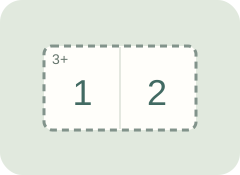
The two numbers add to the target 3. Placing 2 then 1 gives the same total, provided the row and column rules also fit.
Subtract and divide either way
Subtraction and division cages in this game contain two cells. A 2− cage needs two digits whose difference is 2. A 2÷ cage needs a larger digit divided by the smaller to equal 2 exactly. Their left-to-right or top-to-bottom order does not matter. A cage with one cell fixes that digit.
Enter and correct
Tap a cell, then choose a digit. Arrow keys move; number keys enter; Backspace, Delete or 0 clears an editable cell. Given digits stay fixed. Undo removes one entry. Restart clears only this puzzle after confirmation.
Hints and daily boards
Hint explains one forced digit. Apply this step enters only that digit. Correct conflicting entries before requesting a valid hint. Eight practice and four separate daily boards have one solution each. Daily boards use the UTC date and save independently.
These arithmetic-cage conventions were checked against Calcudoku.org. Cagewhistle’s small grids, cage layouts, diagram and interface are original.